THYMALLUS LAB / 01
Same WF.
Different character.
Sometimes you need to cast farther. Other times you want to land a dry fly almost silently. Choose your goal.
01 WHAT DO YOU WANT TO ACHIEVE ON THE WATER?
Choose a situation. The profile and explanation will adapt.
More situations
TWO WAYS TO ACHIEVE DISTANCE
Choose a profile and watch the main diagram change.
Select both profiles. One makes shooting line easier; the other helps control a longer length of line. Distance also depends on technique.
I want to adjust the profile myselfHead and front taper
HEAD LENGTH
FRONT TAPER
Why does it work?Technical explanation
LAKE · DISTANCE
A quick cast with a shorter head
On a lake, a shorter head can make it easier to shoot line quickly, especially if you do not carry many metres in the air. A short front taper can turn over a leader more positively, even with a bulkier fly. Total casting distance also depends on the rod, the line's actual weight, wind and technique.
LAKE · DISTANCE
You can combine distance with a gentler presentation
A short head remains relatively quick to shoot. A longer front taper transfers energy more progressively, which can help with lighter flies and softer landings. In wind or with a large streamer, however, leader turnover may be more difficult.
LAKE · DISTANCE
When you want to control a longer cast
With good technique, a longer head lets you carry and control more line in the air. A shorter front taper transfers energy more forcefully, which can help with streamers or wind. This profile calls for proper timing, though; it does not guarantee greater distance by itself.
LAKE · DISTANCE
A longer cast does not have to mean a harder cast
A longer head can improve control of longer casts, while a longer front taper can encourage a more delicate presentation. With heavy flies or strong wind, it may take more work to turn the leader over. The specific line, rod and casting technique still determine the result.
RIVER · DELICATE PRESENTATION
A short cast does not automatically mean a soft landing
On a small river, a short WF head can be practical because its weight comes into play quickly at short distances. A short front taper, however, may transfer energy too forcefully for a delicate dry-fly presentation. Good technique, the right leader or a softer taper can help.
RIVER · DELICATE PRESENTATION
When a quiet dry-fly landing matters
On a heavily fished river, you often need to present the fly discreetly rather than cast as far as possible. A shorter head can be practical for shorter casts, and a longer front taper can help transfer energy progressively into the leader. Leader diameter, length and casting technique still matter.
RIVER · DELICATE PRESENTATION
Line control, yes. Delicacy, not automatically.
On a wider, open river, a longer head can help you control more line in the air. A short front taper still tends to turn the leader over more positively. A more progressive energy transfer may suit very wary fish; a 16 m head can also be impractical in confined spaces.
RIVER · DELICATE PRESENTATION
Delicate presentation on a wider river
On an open, heavily fished river, a longer head can help an experienced caster control longer casts. A longer front taper can support delicate dry-fly presentation. On short stretches or where space is limited, such a long head may offer no advantage.
LARGE STREAMER
You need to turn over a bulky fly reliably
A shorter head may allow quick line shooting, while a shorter front taper transfers energy to the leader more forcefully. With a large or heavy streamer, however, actual line weight and its distribution toward the front of the head matter too.
LARGE STREAMER
A gentle taper is not always an advantage
A shorter head remains quick to use, but a longer front taper transfers energy more gradually. With a large, wind-resistant streamer, this may make full leader turnover harder. A suitable rod, head weight and leader can help.
LARGE STREAMER
A longer head, a powerful front end
A shorter front taper may turn over a leader well with a larger streamer. A longer head, however, means more line to control during the cast. Consider available space, wind and the specific line's characteristics.
LARGE STREAMER
A large fly and progressive energy transfer
A longer head can support control in a long cast, and a longer front taper can transfer energy more gently. With a bulky fly, however, that can make leader turnover harder. Without weight specifications, there is no clear-cut answer.
QUICK DELIVERY
Get the line into the air quickly
A shorter, appropriately weighted head may load the rod with less line outside the tip and let you shoot without many false casts. A typical example is saltwater fishing: a feeding fish suddenly appears, and you must get the fly in front of it quickly and accurately. A short front taper also transfers energy more forcefully, which can help with bulkier flies.
QUICK DELIVERY
Quick delivery with a softer landing
For a short-notice cast, a shorter head can be practical. A longer front taper can transfer energy more progressively into the leader. The combination can work well with a lighter fly when an aggressive front end is not needed.
QUICK DELIVERY
A long head needs more preparation
A longer head can help an experienced angler control more line in the air. But if you first need to extend the entire long head, a spontaneous short cast may not be as quick. A shorter taper does not change that basic limitation.
QUICK DELIVERY
Control and delicacy rather than maximum speed
A long head can support control, and a longer front taper can soften the presentation. If you need to cast as quickly as possible to a suddenly appearing fish, though, a shorter and suitably weighted head may be more practical.
On a lake you may prioritize distance; with dry flies on a heavily fished river, accuracy and a soft landing. Head and front-taper length help you choose a compromise. But no WF line can fix faulty casting technique by itself.
THYMALLUS LAB · These are model profiles, not specifications for actual lines. Lengths are illustrative and thickness is deliberately exaggerated — geometry alone does not determine the exact weight distribution. The animation runs only when settings change.
QUICK QUIZ · 1 QUESTION
Got it?
You keep the WF head length unchanged. You want a gentler dry-fly presentation. Which front taper would you try first?
Try 5 real-world situationsOptional quiz · from basic to advanced
Now you are deciding based not on definitions, but on what actually happens on the water. Choose the most sensible answer for each question. There is no score; experiment freely.
SCENARIO 01 / 05
A fish is feeding and I have only a moment. What helps me cast quickly?
SCENARIO 02 / 05
A strong headwind is blowing. What matters most when choosing a line?
SCENARIO 03 / 05
I want to cast far but accurately. What could help?
SCENARIO 04 / 05
My casting technique still needs work. Which head should I choose?
SCENARIO 05 / 05
Calm conditions on a heavily fished river. Is WF or DT better for a gentle landing?
WHAT HAVE WE LEARNED?
Not all WF lines behave alike.
A fly line WF (Weight Forward) has a more pronounced front head followed by a thinner section called the running line. Our first infographic shows how, even with the same WF designation, differences in head and front-taper length can change casting and fly presentation.
If you want to see just how much the taper alone can change, return to the first graphic. Keep the head length the same and switch only the front taper.
But what if you need to control a longer line on a river, mend its position on the water or cast with little room behind you? Adjusting the WF taper alone will not explain the whole problem. You also need to understand another line design.
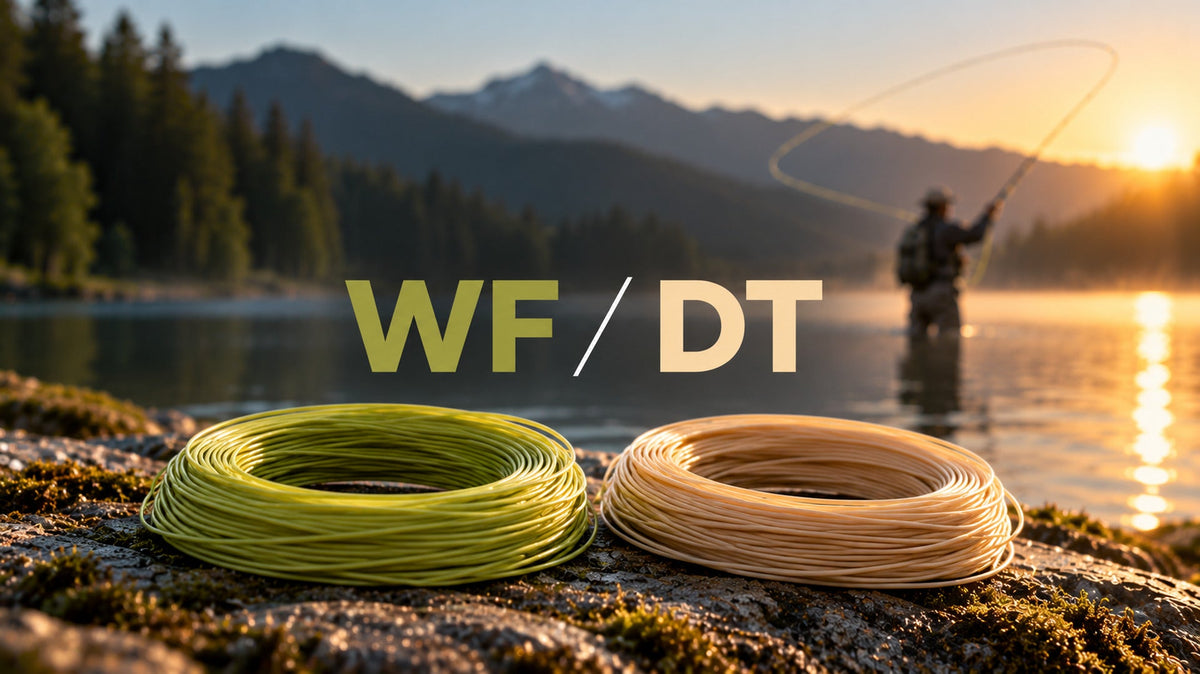
What if you use DT instead of WF?
EXPERIMENT 02 / WF AND DT
Two designs. Different possibilities.
Select a line type and see what really changes in its profile.
MORE PRONOUNCED HEAD · THIN RUNNING LINE
LONG BELLY · MATCHING TAPERS AT BOTH ENDS
WF: Most of the weight is concentrated in the front head. As you cast, it helps pull the thinner running line behind it, making line shooting easier for distance.
DT: The line has a long belly and similar tapers at both ends. It can work very well for roll casts and mending the line on the water.
Why is it not so black and white?
DT does not automatically mean a more delicate fly presentation. Delicacy depends strongly on the front taper, leader and technique. A WF line with a longer head may also excel at roll casts, line control and mending. A short-head WF often makes quick line shooting easier. Choose by actual design and fishing style, not just two letters.
One small DT advantage: If both ends are identical, you can reverse the line when one end wears out.
Schematic geometric profiles, not weight measurements of specific products. Both designs come in many variations.
FOR THE CURIOUS AND EXPERIENCED
Why can two WF lines behave so differently?
The first two experiments showed the differences visually. Now let's look at what happens during a real cast. Each question below has a short answer and more detail if you want to dive deeper.
01 / WEIGHT
Why isn't it enough to know that both lines are WF #5?
The same designation does not mean the same cast. What matters is where the weight is concentrated and how much line you are carrying in the air.
Explain it in technical detail
For standard single-handed fly lines, the AFFTA line class refers to the weight of the first 30 feet (approximately 9.14 m), excluding the short level tip. For example, class #5 has a target weight of 140 grains, around 9.1 g. That is not automatically the weight of the entire head.
Two WF #5 lines can have different head lengths, different front and rear tapers and different weight distributions. Some specialized models are also deliberately heavier than their nominal class suggests. Check the specifications of the actual model, not just the number on the box.
02 / HEAD LENGTH
Does a 16 m head automatically mean a longer cast?
No. A longer head can provide control; a shorter one may allow quicker shooting. Technique and casting distance both matter.
Explain it in technical detail
A WF head comprises the front taper, the belly (belly) and the rear taper. A shorter head may be easier to extend beyond the rod tip and then shoot the thin running line behind it. That is useful when quickly casting to a suddenly appearing fish, for example.
With a longer head, a skilled angler may carry more line in the air, control the loop and work more accurately over greater distances. This requires timing, space and enough energy. What matters is not only the head's absolute length, but also the length of line you usually castand the shape of the rear taper.
Our 9 m and 16 m figures are illustrative examples of two design philosophies, not fixed boundaries between line types.
03 / FRONT TAPER
Why does one line make it easier to present a dry fly, and another a large streamer?
The way energy is transferred changes. A longer, gentler front taper often supports delicate presentations; a shorter, more powerful one helps turn the leader over positively.
Explain it in technical detail
During casting, energy travels through the fly line into the leader and fly. A longer front taper that narrows gradually can transfer energy more smoothly. This may benefit a small dry fly presented to a wary trout. A shorter, heavier front taper can turn over a leader more forcefully with a large or wind-resistant fly.
The taper alone does not determine the effect. Also important are head weight, the fly's aerodynamic drag, leader length and construction, wind and casting technique. That is why there is no single universal line for every streamer or every dry fly.
04 / LINE CONTROL
Is DT automatically better than WF for roll casts and mending?
Not necessarily. DT has a long belly, but modern WF lines with a longer head and a suitable rear taper can offer excellent control too.
Explain it in technical detail
A roll cast uses tension against the water surface and a correctly formed loop rather than a conventional back cast. Mending means repositioning a floating line on the water so the current disrupts the fly's drift as little as possible. In both cases, the amount of thicker, heavier line you still control matters.
DT has a fuller belly along much of its length, while a short-head WF transitions sooner to a thin running line. But a longer WF head, especially with a gradual rear taper,can work very well for mending and roll casts too. Judge the difference from the actual design, not the DT or WF abbreviation alone.
05 / LIMITS OF THE DIAGRAM
What does our animation still not tell you?
The profile is only part of the story. The same line outline does not automatically mean the same weight, sink rate or rod feel.
Explain it in technical detail
Our SVG diagram illustrates where the line is relatively thicker and thinner. It does not show the exact density of each layer, core composition, actual weight along the length, stiffness, friction or coating. You therefore cannot reliably calculate how a specific line will load a specific rod from this diagram.
Similarly, WF versus DT describes shape, not sink rate. A floating (floating), intermediate and sinking (sinking) line addresses a different question: at what depth do you want to fish the fly? We cover that separately in How to choose a fly line: floating, intermediate or sinking?
BEFORE BUYING A LINE
Don't just ask for WF or DT. Explain what you want to achieve.
A good retailer needs to understand how you fish. Saying “I have a #5 rod, give me a WF5” is not enough. Two lines with the same designation can perform very differently on the water.
HERE'S HOW TO START THE CONVERSATION
“I mostly fish lakes. I want to reach fish farther away. What head length and weight would suit my rod and casting technique?”
“I fish dry flies for wary trout. A discreet landing matters to me. What front taper and leader would you recommend?”
“I want to cast bulkier streamers and need reliable leader turnover. Which head weight and front taper are suitable?”
“I need to react quickly and cast without many false casts. Which line can load my rod effectively at the distances I usually fish?”
This sentence reflects the goal you selected in the first infographic.
What should the retailer ask you?
A narrow river at 8–12 m, open water at 20–25 m, or both? Your usual casting distance matters more than your personal record.
Small dry flies, nymphs or large streamers? Their size and wind resistance affect what the line and leader must do.
Brand, model, length, AFTMA class and your actual problem are more useful than the number #5 alone.
Open lakes, overgrown banks, strong wind, or roll casts with no back-cast room? The priorities change accordingly.
And what should you ask?
- What are the head length and actual head weight of this specific line? Is the weight given for the first 9.14 m or for the full head?
- Where is the weight concentrated? What are the front and rear tapers, and what do they mean for my flies and casting distances?
- How will it perform on my rod? How does it differ from the line I use today?
- What will I gain, and what will I give up? Is my priority quick delivery, distance, a soft landing or line control on the water?
The right line is not the one with the most superlatives on the packaging. It is the one that best suits your fishing style, rod and what you want to achieve on the water.
FROM THEORY TO THE THYMALLUS RANGE
Three WF lines. Three different heads.
The model graphic used 9 and 16 metres. Now compare three actual lines from our shop. Their head lengths differ, although all three example variants have a nominal #6 class and a slow intermediate sink rate.
01 / Quicker delivery
Vision Hero Coast 95
9.5 mHEAD · COMMON SCALE TO 16 M
WF-6-I · slow intermediate
A compact head for coastal fishing. A good example of a profile that may make shooting line quickly easier.
Explore the specifications02 / Lake versatility
Vision Still Hero 120
12 mHEAD · COMMON SCALE TO 16 M
WF-6-SI · slow intermediate
A medium-length head with a smooth transition. An example of balance between shooting line and casting control.
Explore the specifications03 / Longer head, more control
Vision Stillmaniac
13 mHEAD · COMMON SCALE TO 16 M
WF-6-SI · slow intermediate
A longer head designed for lake casting. Its benefits depend on the angler's ability to carry line in the air.
Explore the specificationsWe are comparing lengths, not performance. The bars show only head length on a common scale, not actual tapers or weight distribution. The same AFTMA class and sink rate do not guarantee identical behavior. When buying, also check head weight, the specific variant and rod compatibility.
REAL-WORLD QUESTIONS · OPEN DISCUSSION
Seven questions that don't have one-sentence answers.
On the water, two similar lines can feel completely different. Sometimes the profile matters; at other times it's the coating or even the angler's experience. Choose the question that interests you. And feel free to disagree — real-world experiences could inspire the next THYMALLUS LAB.
01Why do I cast better with one new WF line than another?
Even two new lines both marked WF5F can have very different characters.
WF5F describes the design, nominal class and floating version, not exactly how a line casts. Differences may lie in actual weight, its distribution, head length, front and rear tapers, core and coating.
One line may load a rod comfortably at just 10 metres, while another comes alive on a longer cast. Compare both lines on the same rod, with a similar fly, at a distance you actually fish.
Discussion question: Where do you notice the greatest difference: rod loading, timing, accuracy or shooting line?
02If I want to cast far on a lake, does the surface of a WF line matter too?
Yes. The coating and running line affect friction as the line passes through the guides, but neither guarantees a longer cast.
As you shoot line, the running line passes through the rod guides. Its diameter, material and coating affect resistance. That is why manufacturers develop smooth coatings and some textured surfaces designed to reduce friction.
Final distance also depends on line speed, loop shape, head length and weight, wind and technique. A line that feels smoother to the touch does not necessarily produce less friction in a real cast. Even a good coating loses some of its advantage when dirt builds up.
Discussion question: Have you noticed a difference in distance on the same rod after changing or cleaning your line?
03Can I learn everything I need from a fly-line box?
Not always. The WF5F marking alone cannot describe the complete design.
The packaging may omit the lengths of individual tapers, exact total head weight, true weight of the first 9.14 m, core type, recommended temperatures or coating treatments. Some figures appear in the manufacturer's technical charts, not on the box.
A retailer can explain how these specifications relate to your rod, casting distance and flies. Ideally, they have technical data and perhaps first-hand experience. But they should distinguish that experience from measurable specifications. You do not have to rely solely on their opinion: ask for the exact model designation and manufacturer data.
Discussion question: Which specification do you most often find missing when buying a line?
04Why don't I like a new WF line from another brand, even though the specifications say it suits my rod?
Technical compatibility does not guarantee the same casting feel or a match for your favorite line.
Two lines may share a class, similar head length and even comparable total weight, but have different weight distributions, stiffness, core stretch, material memory or coating friction.
Every angler also has their own rhythm and technique. A line that helps one angler enormously may feel too aggressive or too slow to another. When switching brands, tell the retailer the exact name and generation of your previous line and what you liked about it.
Discussion question: Which line suited you better after changing brands, and at what distance?
05Could my favorite line be discontinued, with its new generation feeling different?
Yes. The same name or successor designation does not guarantee identical construction.
A manufacturer may change taper profiles, weight distribution, core or coating. A new generation can be objectively improved in some ways and still suit your rod and casting style less well than the old one.
Sometimes you can find older models as remaining stock, but long-term availability is not guaranteed. Keep the exact name, model designation, year or generation and technical chart for a favorite line. Also check the condition of old stock.
Discussion question: Is there a discontinued line you would buy again immediately if it returned in its original form?
06Are there fewer fly-line manufacturers worldwide than fly-line brands?
Yes — the brand on the box is not necessarily the actual manufacturer. But a reliable worldwide factory count cannot be determined just from the number of brands.
Some companies manufacture their own lines; others use external OEM or private-label production. Northern Sport Fishing, for example, publicly offers custom fly-line manufacturing for other brands.
That does not mean two brands made in the same factory automatically sell identical lines. A customer may specify its own taper profile, materials and quality standards. Without concrete evidence it would be irresponsible to claim where a particular brand's line is made, or that it is merely rebranded.
Discussion question: What matters more for a fly line: brand name, country of manufacture or exact specifications?
07How often should I clean a fly line to preserve its performance?
With normal use, checking and cleaning the line as needed after roughly 2–5 outings is reasonable; clean more often in demanding conditions.
Scientific Anglers recommends cleaning floating lines roughly every 2–3 outings, while Orvis suggests around five in normal conditions. Dirty water, sand and intensive casting may call for earlier cleaning. After saltwater fishing, rinsing your equipment, including the line, with fresh water is sensible.
Follow the manufacturer's cleaning instructions. Gentle washing, clean water and a soft cloth will usually help. Dressings and treatments made for floating lines are not automatically suitable for sinking models. Cleaning will not repair a cracked or damaged coating.
Discussion question: Have you ever found that an older line floated better or shot more freely after cleaning?
WANT TO EXPLORE ANOTHER TOPIC?
Which line do you use?
Share your experience or question in the comments. It helps most if you include the line model, rod, usual casting distance and what works or feels wrong during your cast. Interesting questions may become future articles. Comments in the Fly Fishing Advice blog are moderated.
CONCLUSION · THYMALLUS LAB
You are no longer just looking for a line. You know what to ask.
First you saw how a WF profile changes. Then you compared WF and DT. Now you know what to ask when choosing an actual line. And when someone claims one type is best at everything, you know why it's worth asking further questions.
Back to the first experiment ↑Technical sources and methodology
The explanations are based on principles of fly-line design and available manufacturer data. Useful technical sources: Scientific Anglers – Understanding Fly Line Tapers, Scientific Anglers – Taper Design Fundamentals and an overview of AFFTA line-weight specifications.
Additional verifiable sources for the real-world questions: Scientific Anglers – cores and coatings, RIO – coating technologies, Northern Sport Fishing – OEM manufacturing, Scientific Anglers – line cleaning, RIO – line maintenance.
All THYMALLUS LAB diagrams are deliberately simplified. They do not represent measurements of any specific product or guarantee casting distance or fly presentation. The complete setup and technique determine the outcome.